TECHNICAL RESOURCES
Browse by Category:
Pumping Liquids with Entrained Gas
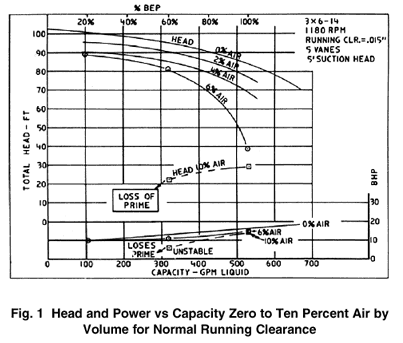
Pump applications in many industrial processes involve handling liquid and gas mixtures. The entrained gas may be an essential part of an industrial process, or it may be unwanted. The Pulp and Paper industry, for example, injects from between 4% and 10% air into a dilute pulp slurry as part of the ink removal process in a flote cell used in paper recycling. Many chemical and petrochemical processes also involve pumping a two phase flow. Unwanted entrained gas can result from excess agitation or vortexing due to inadequate submergence on the suction of a pump.The proper selection of a centrifugal pump for liquid and gas (two phase) mixtures is highly dependent on the amount of gas and the characteristics of the liquid. The presence of entrained gases will reduce the output of centrifugal pumps and can potentially cause loss of prime. Conventional pump designs can be used for low percentages by volume (up to 4%), while special modified impellers can be used effectively for up to 10% gas by volume. Performance corrections are required in all cases with gas content above approx-imately 2%. Gas concentrations above 10% can also be handled, but only with special design pumps (pumps with inducers, vortex pumps, or pumps with gas extraction).
Virtually any type of centrifugal pump can handle some amount of entrained gas. The problem to be addressed is the tendency for the gas to accumulate in the pump suction inhibiting flow and head generation. If gas continues to accumulate, the pump may lose prime. Fig. 1 shows how the performance of a standard end suction pump is affected by various amounts of air. With a minor perfor-mance correction, this type of pump is reasonably efficient in handling up to approximately 4% entrained gas.